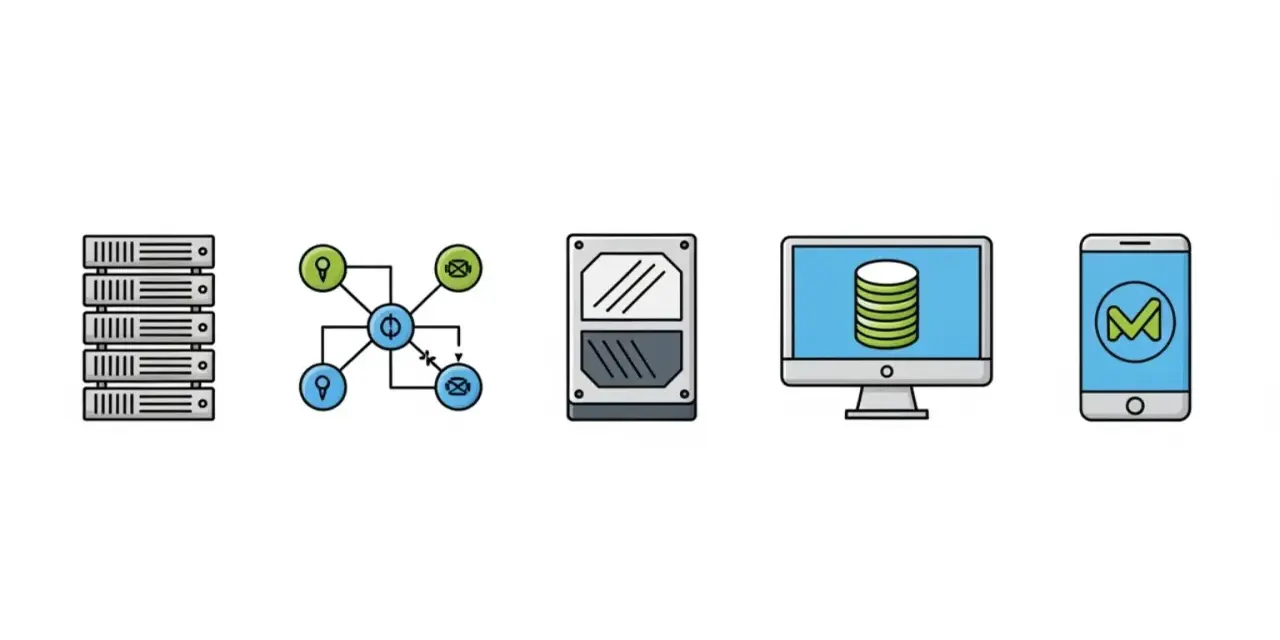
The practical version at a glance
- Virtual networking is about control, not just connectivity. The best systems centralise policy and automate repeatable change.
- VXLAN-style overlays scale far beyond VLANs. A 24-bit VNI gives 16,777,216 possible logical segments, although operations usually become the real ceiling first.
- Underlays carry packets, overlays define boundaries. If those layers are mixed up, troubleshooting gets messy fast.
- UK hybrid estates gain the most when they need consistent segmentation across data centres, cloud regions, and branch sites.
- Selection should start with automation, visibility, and exit options, not feature checklists.
What it actually does in practice
I usually describe this layer as the point where network intent stops being hard-coded into boxes and starts being expressed as policy. You define logical networks, decide who can talk to whom, and let software keep those boundaries consistent as workloads move. The real value is repeatable control, not the novelty of drawing another virtual boundary.
That distinction matters because classic VLAN-based design runs into scale and operational limits quickly. Traditional VLANs top out at 4,094 usable IDs, while VXLAN-style overlays use a 24-bit segment identifier and expand that namespace to 16,777,216 logical networks. The protocol ceiling is generous, but I would not confuse raw scale with real readiness. Governance, observability, and change control usually become the constraint long before the identifier space does.
Modern platforms also have to handle more than VMs. In 2026, a useful virtual networking layer should cope with containers, bare metal, and mixed tenancy without forcing you into separate policy models for each runtime. That is where the whole idea either becomes useful infrastructure or turns into another abstraction that only engineers can admire. The next question is how those logical boundaries are built and enforced.

How overlays, underlays, and segmentation fit together
Cisco’s VXLAN guidance is a useful shorthand here: the underlay is the IP fabric, and the overlay rides on top of it. The underlay moves packets. The overlay decides what those packets mean in terms of tenant isolation, workload grouping, and policy boundaries. If you separate those responsibilities cleanly, troubleshooting becomes much less theatrical.
In simple terms, the common building blocks look like this:
| Component | Role | Why it matters |
|---|---|---|
| Underlay | Carries encapsulated traffic across the physical network | Determines latency, resilience, and path choice |
| Overlay | Defines the logical network seen by workloads | Creates isolation without rebuilding the fabric |
| VTEP | Encapsulates and decapsulates traffic at tunnel endpoints | Connects local endpoints to the virtual network |
| Control plane | Distributes reachability and policy information | Reduces manual configuration and drift |
| Policy engine | Applies segmentation and access rules | Lets security travel with the workload, not the subnet |
The phrase I care about most here is microsegmentation. It means pushing security closer to the workload edge, so you can block unnecessary east-west traffic without forcing everything through a central choke point. That is especially useful when one compromised workload should not be allowed to wander through the rest of the environment. Once that model is clear, the real design conversation moves to where it fits in an actual estate.
Where it fits best in UK network infrastructure
For UK organisations, the strongest use case is usually hybrid. A London data centre, a second colocation site, a few cloud regions, and some branch connectivity can become awkward very quickly if each environment gets its own hand-built policy logic. A virtual networking approach gives you one way to express segmentation and routing intent across all of it.
I would pay particular attention to three scenarios. First, migration, where workloads move from legacy platforms into cloud services and you need the network to keep up without a rebuild. Second, regulated or sensitive workloads, where isolation is not cosmetic and a single mistake can widen the blast radius. Third, disaster recovery and multi-site design, where you need repeatable topology rather than a pile of one-off peerings.
That is also why centralised management keeps winning in practice. Microsoft’s Azure Virtual Network Manager is a clear example of the model, because it groups virtual networks, applies connectivity and security configuration at scale, and keeps policy consistent across many networks at once. The lesson is broader than one product: if your environment crosses administrative boundaries, the platform has to reduce policy drift, not add another place for it to appear. That brings us to how to evaluate the options without buying extra complexity.
How to choose the right platform without buying more complexity
I would start with five questions: can it automate changes, can I see what it is doing, can it integrate with the rest of the stack, can I recover from mistakes quickly, and can I leave if the model no longer fits? If the answer to any of those is vague, the platform is probably shifting complexity around instead of removing it.
| Criterion | What good looks like | Why it matters |
|---|---|---|
| Automation | API-first control, infrastructure as code, versioned policy | Prevents drift and makes change repeatable |
| Visibility | Flow logs, topology views, policy hit data, traceability | Shortens troubleshooting and audit work |
| Policy model | Central governance with delegated local exceptions | Keeps security consistent without blocking delivery |
| Topology support | Mesh, hub-and-spoke, multi-site, and mixed cloud patterns | Real estates are messy, not textbook |
| Integration | IAM, SIEM, firewalls, SD-WAN, container platforms | Lets the platform fit existing operational workflows |
| Exit path | Exportable policy, documented rollback, standards-based hooks | Reduces lock-in and protects future flexibility |
In practical terms, I think of three broad choices. If most workloads live in one cloud, a native manager is often the cleanest answer. If you need deeper private-cloud segmentation or stronger multi-tenant separation, an overlay-first SDN platform is usually a better fit. If your team has strong platform engineers and wants portability, an open-source control plane can make sense, but only if you are willing to own the operational burden that comes with it. The decision is rarely about features alone, and that is where many projects go wrong.
Implementation mistakes that turn a good idea into extra work
The biggest mistakes are boring, which is why they keep recurring. People buy a new abstraction layer and then run it with the same habits that made the old network fragile.
- Designing topology before the address plan - you end up with awkward summarisation, brittle routing, and no clean way to grow later.
- Ignoring encapsulation overhead - tunnels change packet size behaviour, so MTU has to be validated end to end before cutover.
- Splitting policy across too many tools - if security groups, firewalls, and overlay policy all own different parts of the truth, nobody knows where a rule really lives.
- Treating observability as optional - flow logs, topology maps, and policy hits are not extras, they are what make troubleshooting possible at speed.
- Skipping rollback design - the first bad deployment should be reversible in minutes, not after a weekend of manual repair.
One protocol can give you 16,777,216 logical segments, but your team will not survive that scale if change management is weak. That is the real lesson: the platform can expand the network, but it cannot replace discipline. If you avoid those traps, the final question becomes what you want the platform to make easier over the next two or three years.
What I would prioritise before I approve a rollout
In 2026, I care most about whether the platform is automation-first. If policy cannot live in version control, the environment will drift. If telemetry is not available from day one, the first incident will become a guessing game. And if the platform only works well in the lab, it is not ready for production pressure.
- Policy as code so reviews, approvals, and rollback stay auditable.
- End-to-end visibility so you can see where traffic goes and why a rule fires.
- A mixed-workload migration path for VMs, containers, and bare metal.
- A clear operating model that assigns ownership between network, security, and application teams.
- A realistic test environment that mirrors the underlay, MTU, and policy stack you actually plan to run.
If a platform can do those things, it is reducing friction in the network stack. If it only adds another dashboard, I would treat it as cost, not capability. For UK teams balancing cloud adoption, resilience, and security review pressure, that distinction is the difference between modernisation and churn.